






Paralegal Resume ChatGPT: 5 Reasons Not To Use AI & What To Do
Discover why relying on ChatGPT for your paralegal resume is a risky shortcut. Learn the top 5 pitfalls of AI-generated resumes and how a professional paralegal career coach can truly elevate your career in the legal industry.
Click the play button below to listen to this article. This recording may include exclusive bonus content for followers of The Paralegal View podcast and audiobooks. Please note: Audio versions are not guaranteed for all articles and are typically released a few weeks after publication.
The Allure of AI for Paralegal Resumes: A Risky Shortcut?
You're a paralegal, and you know the drill. Time is your most precious commodity, often measured in those coveted billable hours. So, when the buzz around AI tools like ChatGPT promises to streamline tasks and save you precious minutes, the temptation to apply it to something as tedious as updating your resume can be incredibly strong. Why spend hours crafting the perfect document when a seemingly intelligent algorithm can churn one out in minutes?
It's an attractive proposition, isn't it? A quick prompt, and voilà, a resume appears, seemingly ready to tackle the Applicant Tracking Systems (ATS) and impress hiring managers. But let's be frank: in the dynamic, detail-driven world of legal practice, shortcuts often lead to unforeseen complications. While AI is undeniably transforming the legal landscape, freeing paralegals to focus on strategic, high-value work and enhancing their roles (as evidenced by its automation of 69% of routine tasks), relying on it for your resume can be a time suckers in disguise. It's a classic case of wearing multiple hats, trying to be an AI prompt engineer while also being a legal professional.
As a seasoned paralegal consultant, business coach, and entrepreneur who has guided thousands of legal professionals like yourself, I've seen firsthand the pitfalls of chasing quick fixes. When it comes to your career narrative, AI is not the silver bullet you might believe it is. In fact, for paralegals, using ChatGPT to craft your resume is a risky shortcut that can undermine your professional standing and career trajectory.
Let's delve into the five critical reasons why you should put down the AI tool and pick up a more strategic approach for your next career move.
Reason 1: AI's Generic Output and Lack of Personalization
You’ve likely seen the articles (and maybe even tried it yourself): "Just paste your resume and a job description into ChatGPT, and it will optimize it for you!" Sounds great, right? The culprit? AI's reliance on common patterns and broad generalizations.
The Problem: AI models, by their very nature, are trained on vast datasets of existing text. When asked to generate a resume, they pull from ubiquitous phrases and structures, resulting in content that is often bland, generic, and indistinguishable from countless others. Think about it: how many times have you read "detail-oriented," "strong work ethic," or "team player" on a resume? These are precisely the kinds of generic phrases that AI loves to generate.
Why it Matters for You:
- Failure to Stand Out: In a competitive legal market, a generic resume is a forgettable resume. Your unique experience, the specific nuances of your legal work, and the impact you've had on actual cases or firms get lost in a sea of AI-generated clichés.
- Lack of Authentic Voice: Your resume should tell your story, reflecting your professional voice and personality. AI cannot capture your unique motivations, career aspirations, or the subtle yet significant contributions you've made. It lacks the ability to understand and articulate the "why" behind your career choices.
- Recruiter Recognition: Recruiters and hiring managers are becoming increasingly adept at spotting AI-generated content. They are looking for genuine human narratives, not formulaic responses. A lack of personalization signals a lack of effort and authenticity.
- Your career is anything but generic. Why would you allow an algorithm to make your professional narrative just another template?
Reason 2: The High Stakes of AI Inaccuracy and Hallucinations
You wouldn't submit a brief without meticulously fact-checking every citation, would you? The same rigorous standard must apply to your career document. Yet, this is precisely where AI tools fall spectacularly short.
The Problem: AI, particularly large language models like ChatGPT, is known for a phenomenon called "hallucination"—generating false or misleading information while presenting it as fact. It's designed to predict plausible text, not to verify factual accuracy. If it doesn't have a correct answer, it will invent one that sounds convincing.
Real-World Legal Consequences: We've already seen this play out with disastrous consequences in the legal field.
• Mata v. Avianca, Inc. (2023): It is a landmark case relating to the use of AI and practicing law. Attorneys were sanctioned by a New York federal court for submitting a brief citing several non-existent cases, fabricated by ChatGPT. They were fined $5,000 each and suffered immense professional embarrassment.
• Gauthier v. Goodyear Tire & Rubber Co. (2024): Another attorney faced sanctions in Texas for submitting a response to a summary judgment motion that included non-existent cases and fabricated quotations, admitting to using a generative AI tool ("Claude") without verifying its output.
Why it Matters for Your Resume:
- Fabricated Achievements: If AI can invent legal cases, it can certainly invent or exaggerate your resume achievements. Imagine a hiring manager discovering that a "quantifiable success" on your resume is entirely fictional, or that a "specialized software proficiency" you claim doesn't actually exist in your skill set. The damage to your credibility would be irreversible.
- Misleading Information: AI might misinterpret or misrepresent your past responsibilities, job titles, or dates of employment, creating factual inaccuracies that could easily be flagged during background checks.
- Professional Trust: As legal professionals, our credibility is paramount. Submitting a resume with inaccuracies, whether intentional or AI-generated, undermines the very foundation of trust that clients and employers place in us. You are ethically responsible for the veracity of the information you present.
- In a profession built on precision and factual accuracy, allowing an AI to introduce potential inaccuracies into your resume is a gamble you cannot afford to take.
Reason 3: Limited Contextual Understanding and Nuance in AI-Generated Resumes
Your career isn't just a list of tasks; it's a journey filled with strategic decisions, nuanced challenges, and specific impacts. AI, for all its data processing power, fundamentally lacks the ability to grasp this deeper context.
The Problem: While AI can identify patterns in data, it struggles profoundly with nuance, implicit context, and human judgment. It cannot understand the "why" behind a specific career move, the unique complexities of a case you handled, or the subtle leadership skills you demonstrated while wearing multiple hats in a solopreneur setting. It can process raw data, but it can't translate that into meaningful practical solutions tailored to your specific professional journey.
Why it Matters for Your Resume:
- Missed Opportunities for Impact: A professional resume isn't just about listing duties; it's about showcasing your impact. AI might tell you that you "drafted pleadings," but it can't quantify how those pleadings led to a favorable settlement, saved the client billable hours, or established a new precedent within the firm's workflows. That requires human insight and strategic storytelling.
- Inability to Tailor Effectively: Even with a specific job description, AI struggles to genuinely tailor your experience to the unspoken needs or cultural fit of a particular firm. It can pull keywords, yes, but it can't understand the firm's overarching strategy or the subtle qualities they truly seek in a candidate. One of my coaching clients recently brought up a story about an employee who was fired after relying on ChatGPT for project guidance instead of asking their manager. 'The AI completely missed the mark,' my client realized, 'because it had zero context on what the boss actually expected.' It was a lightbulb moment about the danger of replacing direct communication with AI shortcuts. ChatGPT was wrong because it couldn't know what the boss really wanted. The same applies to a hiring manager's true expectations.
- Ignoring the "Soft Skills" That Matter: In the legal profession, critical thinking, ethical judgment, client interaction, and creative problem-solving are invaluable. Source 1 explicitly notes these as AI's limitations. AI-generated resumes often miss opportunities to highlight these crucial soft skills, which are often the deciding factor in hiring. It can't articulate how you handled a difficult client or navigated a complex ethical dilemma.
- Your career narrative deserves more than a surface-level, keyword-stuffed summary. It demands a deep understanding of your contributions and their context.
Reason 4: Data Privacy and Confidentiality Risks with Public AI Tools
As a legal professional, you live and breathe confidentiality. You safeguard client data with meticulous care. Why would you treat your own professional history—which often includes sensitive details about your former employers, cases, and responsibilities—any differently?
The Problem: Most public-facing AI tools, like the free versions of ChatGPT, are designed to learn and improve from user inputs. This means that anything you type into a prompt, including your entire resume and any accompanying job descriptions, may be used to train the AI model. This isn't just theoretical; it's a core operational function.
Why it Matters for Your Resume and Professional Ethics:
- • Exposure of Sensitive Information: Your resume likely contains details about past employers, practice areas, specific case types, and even software tools used. While not client-specific, this information can still be considered proprietary or sensitive. Uploading it to a public AI tool means relinquishing control over that data.
- Breach of Employer Trust (by Analogy): Consider the implications if an HR manager, as described in Source 7, used a personal ChatGPT account to draft internal documents, inadvertently uploading company-specific performance data. This raises serious concerns about data integrity and confidentiality. While your resume isn't client data, it reflects your professional activities and could indirectly reveal sensitive aspects of your former firms or roles.
- Ethical Obligations: Legal professionals have a duty to protect confidential information. While your resume itself might not contain privileged client data, the act of inputting detailed professional history into a system that may not guarantee privacy creates an unnecessary risk and demonstrates a potential lapse in judgment regarding data handling. This can create a significant dissonance with the professional standards you are expected to uphold.
- Lack of Control: Once your data is ingested by a public AI model, you have no control over how it's stored, processed, or potentially used in future outputs for other users. This lack of a secure, "closed-system" environment is a critical distinction that general AI tools lack, as highlighted by Source 6.
- Protecting your professional history is an extension of your ethical responsibilities. Don't compromise your data integrity by feeding it into a system with opaque privacy practices.
Reason 5: AI Perpetuates Bias and Lacks True Strategic Career Foresight
Your career path is a journey of growth, aspiration, and unique contributions. You wouldn't want it to be dictated by outdated biases or limited to what an algorithm thinks is typical.
The Problem: AI models are trained on historical data, which inherently reflects existing societal biases. If the training data includes resumes or job descriptions that historically favored certain demographics or career paths, the AI can internalize and perpetuate those biases in its outputs. Moreover, AI operates on "what was," not "what could be." It lacks the capacity for genuine market research into emerging trends that would strategically position you for future roles, or the empathetic understanding needed to help you pivot or highlight transferable skills. Source 4 explicitly mentions AI perpetuating biases from historical data.
Why it Matters for Your Resume and Career Strategy:
Embedded Biases: An AI-generated resume might inadvertently screen you out by omitting keywords, phrasing, or experiences that challenge conventional norms, simply because its training data didn't emphasize them. This could happen without your awareness, limiting your access to diverse opportunities.
Absence of Strategic Foresight: A resume isn't just about recounting the past; it's about signaling your future potential. AI cannot understand your ambitions, your desire for specific career growth, or how your unique combination of skills might position you for a niche solopreneur role or a cutting-edge legal tech position. It simply can't offer the practical solutions needed for a strategic career pivot.
Lack of "Human Bug" Understanding: As wisely articulated in Source 8, AI doesn't understand the "human bug"—our need for vulnerability, growth, and direct communication. It won't challenge your assumptions, ask the difficult questions about your career gaps, or help you articulate the story behind a complex career decision. It offers a "thin veneer" of plausible text, but lacks the depth of human coaching that leads to true self-reflection and a powerful career narrative.
Undermining Your Unique Value Proposition: Your professional narrative is more than a compilation of skills and dates. It's about your unique value, your problem-solving approach, and your vision for your career. AI cannot help you articulate this, potentially leading you to undercharge your value by not adequately representing your worth.
In a rapidly evolving legal world, your resume needs to be a forward-looking, strategically crafted document that transcends historical biases and positions you for growth, not a static reflection of the past.
The Superior Alternative: Why Professional Resume Services Trump AI
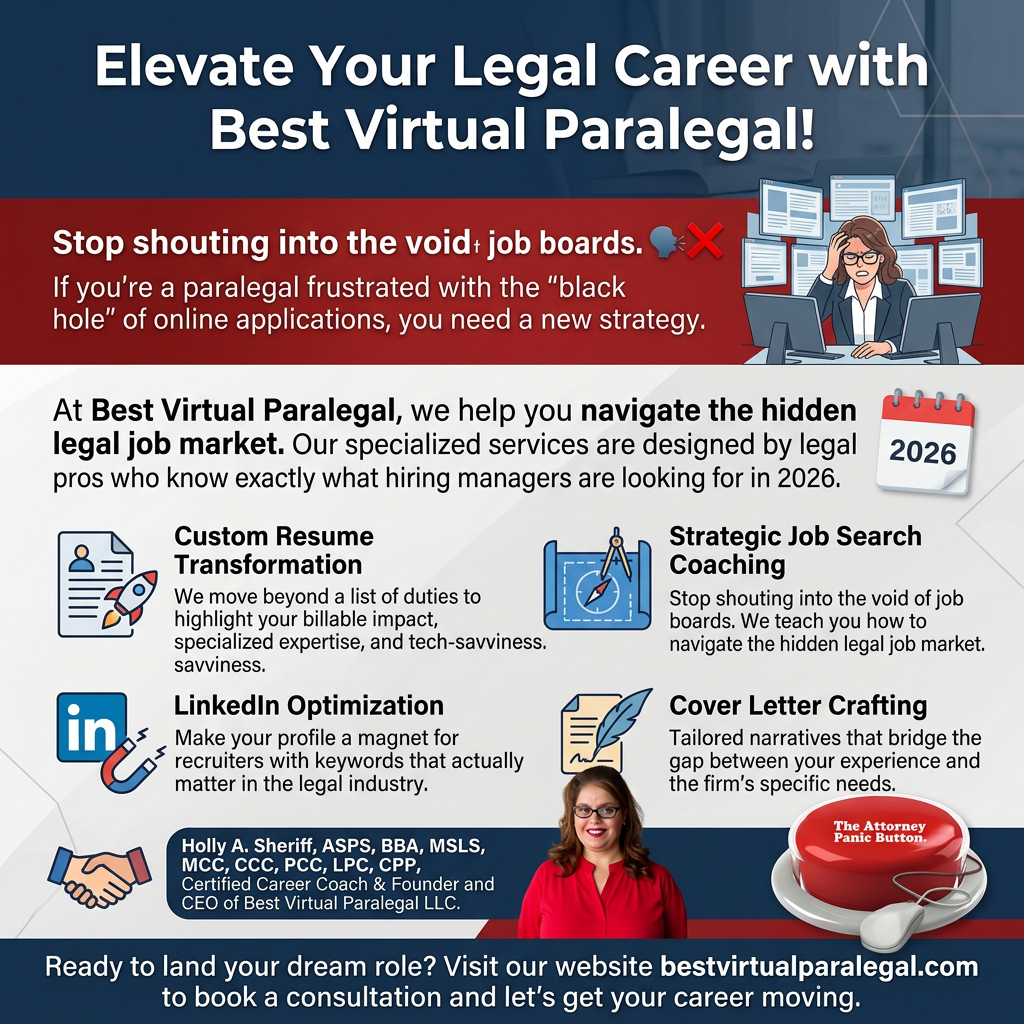
So, if AI isn't the answer, what is? The answer lies in human expertise—strategic guidance that understands the legal landscape, the nuances of your career, and the art of professional storytelling. This is where a dedicated professional resume service, powered by a seasoned paralegal career coach, becomes an invaluable investment.
How a Professional Paralegal Career Coach Elevates Your Resume (Instead of AI)
- You’ve built a career on precision, judgment, and strategic thinking. Don't compromise that by relying on an algorithm for your most important professional document. Instead, leverage the unparalleled value of human expertise.
- Here’s how a professional paralegal career coach, like Holly Sheriff, founder of Best Virtual Paralegal LLC, transforms your resume into a powerful career asset:
- Personalized Strategy & Deep Dive: Forget generic. A professional coach engages in a comprehensive conversation with you, delving into your career history, accomplishments, and aspirations. They understand your unique value proposition, helping you articulate the "why" behind your career moves, even when you've been wearing multiple hats.
- Strategic Storytelling: It's not just about listing tasks; it's about showcasing impact. A coach helps you translate your experiences—from managing complex workflows to assisting with high-stakes litigation—into compelling narratives that highlight your contributions and quantifiable achievements. They ask the right questions to uncover the untold stories that truly differentiate you.
- Industry-Specific Nuance & ATS Optimization: While AI can pull keywords, a human expert understands the context and importance of those keywords within the legal field. They know which phrases resonate with legal recruiters and hiring attorneys, and how to organically weave them into your resume, ensuring it passes ATS screens while maintaining authenticity and professional polish. They can tailor your resume to the specific demands of a particular baseline price point firm or a unique block scheduling environment.
- Identifying & Articulating Soft Skills: Your ability to think critically, exercise ethical judgment, communicate effectively, and maintain strong client relationships are invaluable. A coach helps you identify and illustrate these crucial soft skills through concrete examples, something AI struggles to do.
- Unbiased & Forward-Looking Perspective: Unlike AI, a human coach provides an objective, unbiased perspective on your career. They help you identify strengths you might overlook, address career gaps strategically, and position you for future growth, anticipating market research trends and helping you craft a resume that speaks to where you want to go, not just where you've been.
- Confidentiality & Trust: When you work with a professional, your data remains private and secure. You're not feeding your sensitive career history into a public, data-ingesting algorithm. This upholds your professional responsibility to maintain confidentiality.
- Refined Language & Polish: A professional resume writer ensures your document is grammatically flawless, uses sophisticated vocabulary (without being verbose), and maintains a formal, objective tone that is appropriate for the legal industry. They eliminate fluff and create a polished, active-voice narrative that establishes high credibility.
- Invest in Your Career: The Irreplaceable Value of Human Expertise
You wouldn't ask an algorithm to represent a client in court, would you? Nor would you trust it to provide nuanced legal advice. Your career, your professional future, and your reputation are equally deserving of human expertise, discernment, and strategic insight. While AI tools promise efficiency, they often deliver a false economy, costing you more in missed opportunities, professional credibility, and ultimately, career stagnation. Your resume is a vital investment in your professional brand. It's the first impression you make, the document that opens doors, and the reflection of your capabilities.
Don't settle for a generic, potentially inaccurate, and strategically limited AI-generated resume. Invest in the proven power of human expertise. Partner with a professional paralegal career coach who understands the nuances of the legal industry, respects your confidentiality, and is genuinely invested in your success. It's not a magic formula; it's a strategic partnership that ensures your resume truly elevates your career.
Author Bio

Holly Sheriff, as a certified career coach and founder of Best Virtual Paralegal LLC, has dedicated her career to helping thousands of paralegals elevate theirs. Her expertise isn't just in resume writing; it's in understanding the legal profession's demands and empowering paralegals to meet them head-on. She's not just fixing your resume; she's investing in your career trajectory.